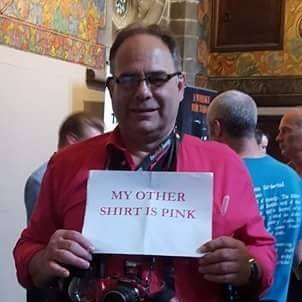
 Martyn Jenkins, whisky cyclist, has been gone for a year.
That’s still hard to accept for most people who knew him in the whisky world. His jovial, kind presence are as memorable as his red - or often faded to pink - shirts.
He was always doing things for others. His Whisky Cyclist website has plenty of tips on how to cycle around Scotland visiting distilleries. He was deeply involved in his workplace union, fighting for the rights of others. Through everything he was amiable, jolly and generous.
Many of my abiding memories of Martyn are of that generosity. For Martyn, whisky was a wonderful thing to discover and learn about - but the true joy lay in sharing it.
Martyn often had a hipflask or a sample bottle with him. He was the kind of person who, when queuing for a whisky show, would magically have a glass and some whisky with him. For many that’s like bringing coals to Newcastle, but for Martyn it was the obvious thing to do. He knew that the show was as much about the people going to it as it was about the whisky.
Sometimes the whisky he brought was old, sometimes it was rare, sometimes it was new, sometimes it was just something he’d found recently and liked. But it was never only his.
The sight of Martyn cleaning a previously used glass, filling it from a sample bottle and then handing around an improbably large measure is one I miss immensely.
We cannot bring Martyn back. But those of us who miss him can take up his mantle. We can make sure that nobody near us ever wants for an interesting dram.
Stirring though such action is, it merely fills the void he has left. We need to go further to celebrate his life.
Martyn passed on whilst still having hundreds of bottles of whisky that he’d accumulated, but not yet opened. Like many of us, he had “special bottles”.
You probably have some yourself. Treasured, but reserved. They sit on a shelf for years. Always waiting for a special occasion, but the last time you thought about it, you weren’t convinced the occasion was special enough. So it will sit on the shelf for another year.
To celebrate Martyn’s life, we should start opening those bottles. Start sharing them. Stop them gathering dust, and use them to create memories.
To reassure you all that this will work, I actually started opening special bottles and sharing them last year. Nobody seems to have minded yet. If anybody asks why, I mention Martyn. More often than not, we share memories and lament our loss.
My only regret is that I should have opened these things when I could have shared them with him. But we cannot change the past - so let us celebrate his life by indulging in the same generosity he would show us, if he were still here.
Martyn Jenkins. 5th August 1955 - 9th April 2018.
You can donate to a charity in Martyn’s name here (for the British Heart Foundation) or here (for Diabetes UK).